← Back to the timeline
2023: Level 5 and the McDougall Creek fire
The peak of the current multi-year drought: the Okanagan hit Drought Level 5 (the maximum) in August, while the McDougall Creek wildfire destroyed hundreds of homes and forced tens of thousands to evacuate, and West Kelowna faced a drinking-water emergency.
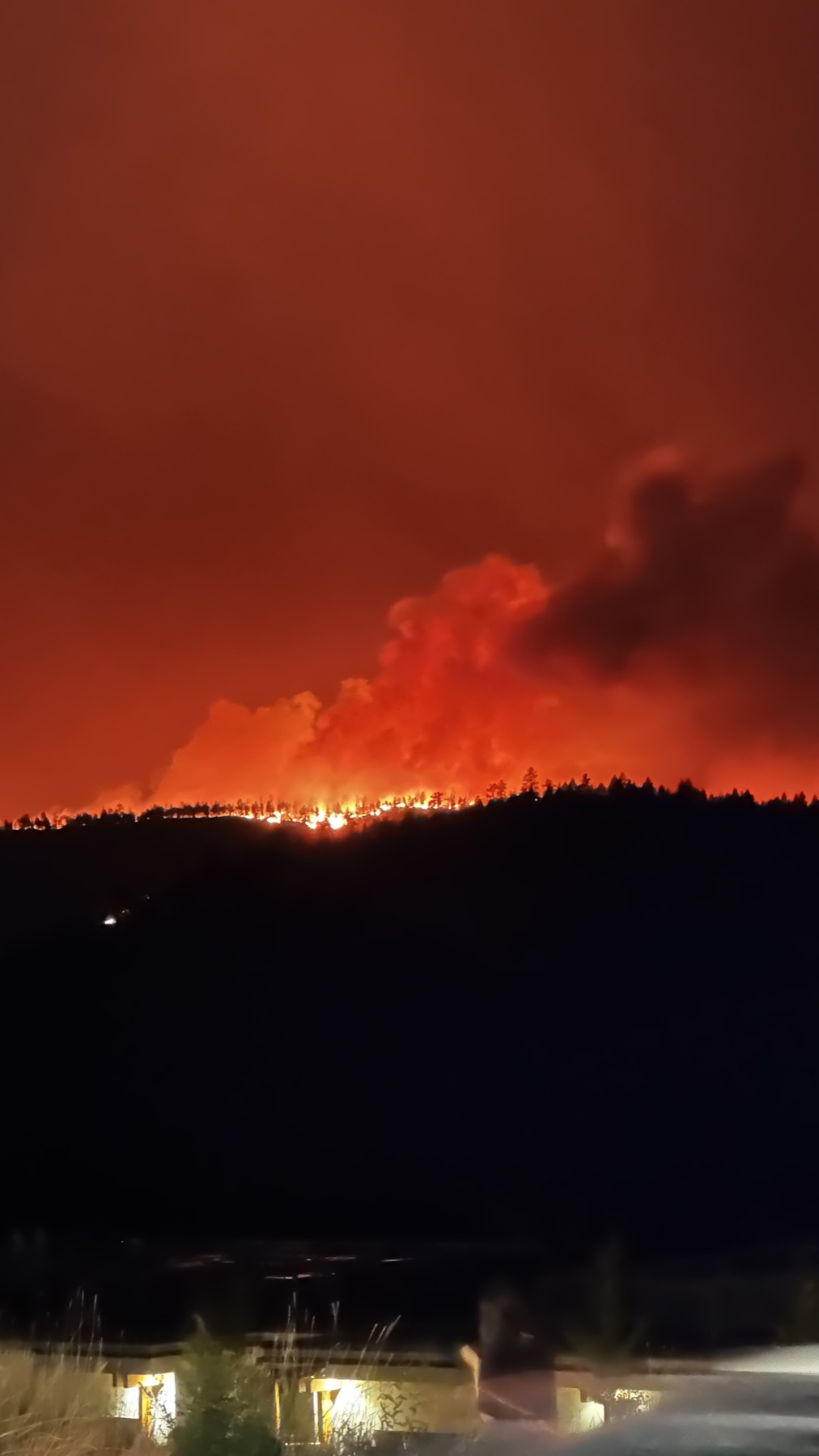
2023 was the peak of the current multi-year drought and one of BC’s worst drought years on record, the year drought, wildfire, and a municipal water-system emergency struck the central Okanagan at once.
Local government & infrastructure
- The Province moved the Okanagan basin to Drought Level 5 (highest on the 0-5 scale) in mid-August 2023, asking residents, industry and businesses to reduce water use wherever possible and observe all watering restrictions, and directing water suppliers with upstream storage to follow release schedules to protect downstream flows. The basin was returned to Level 4 on October 5, 2023. [High] (source)
- During the McDougall Creek wildfire, the City of West Kelowna imposed Stage 4 water restrictions (no outdoor water use) to conserve supply for firefighting, issued a Do Not Consume Order for the Rose Valley water system area (except Sunnyside/Pritchard), and a Boil Water Notice for the Sunnyside/Pritchard system. [High] (source)
- West Kelowna’s new $75-million Rose Valley Water Treatment Plant (about $41 million federal/provincial funding via the Clean Water and Wastewater Fund), then in its final construction phase, was successfully defended from the McDougall Creek fire; Fire Chief Jason Brolund stated all structures were left standing. The plant later opened in November 2023. [High] (source)
- The McDougall Creek fire burned the watershed around the Rose Valley reservoir, the source water for more than half of West Kelowna residents, contaminating the source with sediment, nutrients, metals and organic matter from burned material and making the water persistently harder to treat; the Rose Valley Water Treatment Plant building itself was not damaged. The Do Not Consume Order was downgraded to a Boil Water Notice for the Rose Valley-Lakeview service area by August 30, 2023, then to a Water Quality Advisory by September 22, 2023. [Moderate] (source)
- In August 2023 the Province issued Water Sustainability Act fish-population protection orders in the North Okanagan (Salmon River and Bessette Creek), requiring water users including farmers to cease irrigation (effective on/about August 15, 2023) to protect threatened salmon; these orders expired September 30, 2023 in alignment with the standard April 1 to Sept. 30 irrigation-licence period. [High] (source)
Quality of life
- The McDougall Creek wildfire (started August 15, 2023 near West Kelowna, final size 13,970.4 hectares) destroyed homes across multiple communities: about 70 homes in West Kelowna, 20 on Westbank First Nation, 3 in Kelowna, 2 in Lake Country, and roughly 100 in the unincorporated lakeside communities of Traders Cove and Wilson’s Landing (including the historic Lake Okanagan Resort), with 303 structures impacted in total. No deaths were reported. Insured losses exceeded C$480 million. [High] (source)
- The fire forced mass evacuations: as of August 19, 2023 at least 35,000 people were under evacuation orders and another 30,000 under evacuation alerts across West Kelowna and Kelowna; a provincial state of emergency was declared August 18, 2023, and Kelowna International Airport suspended flights on August 18. [High] (source)
- Wildfire smoke drove severe air-quality impacts across the Okanagan in August 2023: the Ministry of Environment and Climate Change Strategy issued smoky-skies bulletins / air-quality advisories for the Okanagan, Shuswap, Similkameen, Nicola and Columbia regions, and at times Okanagan air quality was ranked among the worst in the world. Health guidance warned of elevated risk for older adults, pregnant women, infants, children and people with respiratory conditions. [Moderate] (source)
- Drought, extreme heat and the August wildfires abruptly ended the 2023 Okanagan tourist season and stressed vineyards, with wildfire smoke exposing grapes to smoke-taint risk; winemakers who had hoped to offset a weak vintage with tasting-room sales were undercut by the wildfire disruption. [Moderate] (source)
- The 2023 BC grape crop saw an estimated 54% loss with financial losses pegged at about C$133 million (per a June 2023 industry report), with 45% of vines suffering long-term damage and 29% needing replanting. This loss was driven primarily by a late-December 2022 cold snap and compounded by 2023 drought, extreme heat and wildfire smoke; it is a BC-wide figure heavily concentrated in the Okanagan. [Moderate] (source)
Environmental flow & fish
- The August 2023 Level 5 declaration was explicitly triggered by fish stress: many fish-bearing Okanagan streams were at historical low flows with several completely dry, and stream water temperatures reached levels described as lethal to fish. Water suppliers with upstream storage were directed to follow release schedules to maintain minimum downstream flows. [High] (source)
- To protect threatened salmon during the 2023 drought, the Province used Water Sustainability Act fish-population protection orders in North Okanagan tributaries (Salmon River and Bessette Creek), restricting water withdrawals and irrigation from mid-August 2023 until the orders expired September 30, 2023. [High] (source)
- The Osoyoos Lake sockeye population (Okanagan Basin sockeye, managed with the Fish and Water Management Tool deployed in 2004) has exceeded its long-standing escapement goal of 35,500 in 12 of the 20 years from 2004 to 2023, per DFO’s escapement-goal review; this frames the stock context but is not a 2023-specific return count. [Moderate] (source)
- On the transboundary Osoyoos system, the IOLBC Fall 2023 update reported Osoyoos Lake operating within its normal (non-drought) rule curve in 2023 (winter band 909.0 to 911.5 feet, Nov 1 2023 to Mar 1 2024), with levels dropping below historical averages only in October; no formal Osoyoos Lake drought-year operational variance was invoked in 2023 in the retrieved records (documented Zosel Dam drought variances are dated 2024, 2025 and 2026). [Moderate] (source)
Level 5 Provincial drought rating
13,970 ha McDougall Creek fire
~303 Structures destroyed
Sources: revelstokereview.com · canada.constructconnect.com · castanet.net · vernonmorningstar.com · en.wikipedia.org · globalnews.ca · wineenthusiast.com · dfo-mpo.gc.ca · ijc.org · vernonmatters.ca · vernonmatters.ca · kelownanow.com